In April 1775, as British troops retreated from Lexington and Concord, a man already in his late seventies stood in their path near Menotomy, Massachusetts — alone, armed, and fully willing to fight. That man was Samuel Whittemore, and what happened next helped turn him into one of the most retold figures in American Revolutionary history.
This article looks at who Whittemore actually was, what shaped him before that April day, what the records say about his confrontation with British soldiers, and how to think carefully about the details that are confirmed versus those that grew in the retelling.
Who Samuel Whittemore Was
Samuel Whittemore was a Massachusetts farmer and experienced soldier with deep colonial roots. His family had been in the region since the 1630s, which placed him squarely in the community of colonial New England that eventually broke with Britain.
The National Park Service describes him as a 78-year-old farmer and veteran at the time of his most famous act. He is remembered primarily as a patriot and soldier, not an entertainer or political figure in the modern sense — but his story has circulated widely enough in history articles, military histories, and genealogy research that he deserves careful, factual treatment.
He is not a celebrity in the entertainment sense of the word. He is something closer to a historic public figure whose story has taken on legendary qualities over time. That distinction matters, especially when separating confirmed facts from later embellishments.
Birth Date, Origins, and Why the Records Conflict
If you search for Samuel Whittemore’s birth date, you will find more than one answer. The National Park Service gives his birth year as 1696. Other sources and genealogical records list February 27, 1694, or July 27, 1696. No single source resolves all the disagreements.
This kind of conflict is common with colonial-era figures. Record-keeping in early 18th-century Massachusetts was inconsistent, and many details were written down long after the fact. The conflicting dates do not undermine the broader historical account — they simply reflect the limits of what survives.
He was reportedly the son of Samuel Whittemore and Hannah Rice or Rix, though genealogical sources vary on this detail too. What is clear is that his family had been part of the Massachusetts colonial community for several generations, which gave him strong ties to the land and to the people who eventually became the first Americans to take up arms against Britain.
His Military Experience and Political Commitments Before 1775
Whittemore’s actions on April 19, 1775, were not impulsive. He had decades of military experience behind him before the first shots of the Revolution were fired.
He served in colonial conflicts including King George’s War and the French and Indian War. Some accounts connect him to the Royal Dragoons, but this detail does not appear equally well documented across all sources, so it is worth treating with caution rather than stating as settled fact.
Beyond the battlefield, Whittemore was also politically active. Before 1775, he reportedly served on committees opposing the Stamp Act, took part in protests against the Townshend Acts, and was involved with the Cambridge Committee of Correspondence. These were organized, community-level acts of political resistance — not fringe activities, but central to how Massachusetts colonists pushed back against British policy.
That background matters. When he stood his ground near Menotomy in April 1775, it was consistent with a long personal and community commitment. He was not a bystander who happened to pick up a weapon. He was a man who had been preparing for that kind of moment, in one form or another, for most of his adult life.
The Confrontation Near Menotomy on April 19, 1775
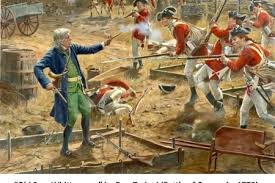
On April 19, 1775, British troops were retreating from Lexington and Concord after the opening battles of the American Revolutionary War. The retreat passed through Menotomy — the area now known as Arlington, Massachusetts.
Whittemore positioned himself along the route and used a musket and pistols to fire on British soldiers as they passed. He was eventually overwhelmed by the soldiers, who shot him in the face, bayoneted him multiple times, and beat him with musket butts.
The exact number of British soldiers he killed or wounded is disputed and difficult to verify from primary sources. The frequently repeated claim that he suffered exactly 13 bayonet wounds appears in later retellings rather than in contemporary accounts, so it should not be taken as a confirmed figure. Similarly, specific claims about how many soldiers he killed should be approached with the same caution — the broad account is well supported, but the precise numbers are not.
What is not disputed is that his injuries were severe and that, by any reasonable expectation, he should not have survived them.
How He Survived — and What Came After
After the attack, Whittemore was found still alive. He received medical care and, against what must have seemed impossible odds, recovered. The National Park Service notes that he went on to live for many additional years and died of natural causes.
His death is generally placed in 1793. Sources disagree on whether he was 96 or 98 at the time, which again reflects the unresolved uncertainty around his birth year. He is associated with the Old Burying Ground in Arlington, Massachusetts.
The combination of extreme age, military experience, severe wounds, and survival is exactly what gave his story lasting power. He is often described as one of the oldest known American combatants of the Revolutionary War, though that claim depends on available records and how “combatant” is defined — so it is worth noting the qualification rather than treating it as a simple, proven fact.
His Family Record
On the family side, Whittemore married Elizabeth Spring around 1720. He later married a widow named Esther Green. The National Park Service records that he had eight children with Esther.
Genealogy databases and user-created family trees offer additional detail about his children, marriages, and possible descendants, but the quality of those sources varies considerably. A name match or surname connection alone does not prove descent from Samuel Whittemore. Anyone researching a possible family connection would need to trace each generation through documented records — birth certificates, marriage records, probate files, land records, church registers, and cemetery entries — to build a reliable case.
It is also worth being careful not to confuse Samuel Whittemore with other people of the same name who appear in colonial and later Massachusetts records. The name was not uncommon, and errors in family trees can compound quickly when researchers assume that any Samuel Whittemore in a record must be the same individual.
Why His Story Has Lasted
Stories that endure usually carry something that feels almost impossible. In Whittemore’s case, the combination of his age, his military discipline, his political convictions, and his physical survival made the account feel almost too remarkable to be true — which is probably why it has been repeated so often and why the details have occasionally grown in the telling.
The core of the story is well supported by the National Park Service, the U.S. Army’s historical records, and accounts from All Things Liberty and similar publications focused on Revolutionary-era history. The embellishments — specific wound counts, exact casualty numbers — are where readers should apply more skepticism.
Whittemore’s story also connects to a broader truth about the opening of the Revolution. The men and women who showed up on April 19, 1775, came from all walks of life and all ages. They were farmers, tradespeople, veterans of earlier colonial wars, and local officeholders. Whittemore fit that picture exactly — and then some.
For anyone interested in early American history, military history, or New England genealogy, resources like StartBusinessAdvice and public historical archives offer useful starting points for exploring how historical figures like Whittemore connect to broader American narratives.
A Final Word on the Legend
Samuel Whittemore was a real person. The essential facts of his life — his military service, his political activism, his confrontation with British troops, his severe injuries, and his survival — are supported by credible historical sources. The finer details, including his exact birth year, the precise number of wounds he suffered, and the exact casualties he inflicted, remain uncertain and should be treated that way.
What is certain is that a man in his late seventies, with decades of military and political experience behind him, chose to stand in the path of a retreating army and fight. Whatever the exact numbers say, that much appears to be true — and it is more than enough to explain why his name has stayed in the historical record for nearly 250 years.
Read Also: