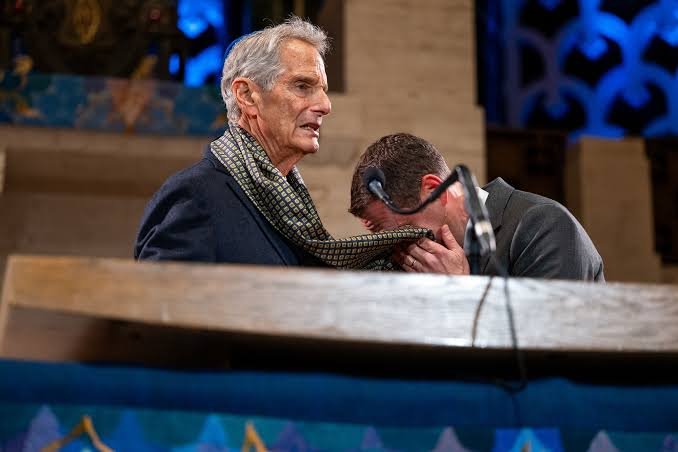
When Daniel Lurie was elected San Francisco’s mayor in 2025, public curiosity quickly turned to his father. Rabbi Brian Lurie is not a household name outside Jewish communal circles, but his career spans more than five decades of leadership in Bay Area Jewish life and national Jewish philanthropy. Understanding who he is helps explain a great deal about the Lurie family’s deep roots in San Francisco.
This article covers who Rabbi Brian Lurie is, what he built during his long career, and how he connects to Daniel Lurie and the broader Haas family story — without confusing the two men or overstating either one’s role.
Who Is Rabbi Brian Lurie?
Rabbi Brian Lurie is a Reform rabbi and Jewish communal executive who has spent most of his professional life in and around San Francisco. He studied at Lafayette College and later received his rabbinical training at Hebrew Union College–Jewish Institute of Religion, one of the main institutions for Reform Jewish ordination in the United States. He was ordained around 1969.
His early career was congregational. From 1969 to 1972, he served as assistant rabbi at Congregation Emanu-El in San Francisco — one of the country’s most prominent Reform Jewish congregations. But his path soon moved away from congregational work and into Jewish communal administration, nonprofit leadership, and national philanthropy.
It is worth being clear from the start: Rabbi Brian Lurie is the father of San Francisco Mayor Daniel Lurie. The two are separate public figures with distinct careers. Much of the current interest in Rabbi Lurie is driven by his son’s political rise, but Brian Lurie’s career stands on its own merits.
His Leadership of the San Francisco Jewish Federation
The longest and most documented chapter of Brian Lurie’s career began in 1974. That year, he became executive director of the San Francisco Jewish Welfare Federation — an organization that has been known under different names over the decades, later called the Jewish Community Federation. He held that role for 17 years, until 1991.
His work there was wide-ranging. He was involved in fundraising, Jewish education, community planning, demographic research, and endowment development. He also worked to build and maintain relationships between the Bay Area Jewish community and Israel — a theme that would run throughout his entire career.
Seventeen years in a leadership role at a major urban Jewish federation is a significant tenure by any measure. It placed him at the center of Bay Area Jewish institutional life during a period of considerable change in both the local community and in the broader American Jewish world.
National Jewish Leadership and Operation Exodus
After leaving the San Francisco federation in 1991, Lurie stepped into a larger national role. He became executive vice president of the United Jewish Appeal, one of the most significant Jewish fundraising organizations in the United States at the time.
In that role, he was associated with the second phase of Operation Exodus — a major effort connected to the emigration and resettlement of Jews from the former Soviet Union following the collapse of the USSR. The operation involved large-scale fundraising and coordination across Jewish communities throughout North America.
It is important to be precise here. Lurie was a significant leader involved in the strategy and implementation of this effort. He should not be described as the sole founder or architect of Operation Exodus, which was a broad communal undertaking involving many organizations and individuals. His role placed him, however, at the center of one of the most consequential Jewish humanitarian efforts of the late twentieth century.
This phase of his career moved him firmly into national and international Jewish philanthropic circles, well beyond his San Francisco base.
The New Israel Fund and the “Living Bridge” Concept
Brian Lurie also served as president of the New Israel Fund, an organization focused on democracy, equality, and civil rights within Israeli society. His involvement with the New Israel Fund reflects a progressive, reform-oriented approach to American Jewish engagement with Israel — one that goes beyond purely financial relationships.
Throughout his career, Lurie developed a concept he called the “Living Bridge.” The idea is straightforward: American Jews and Israelis should maintain sustained, two-way relationships built on shared responsibility and genuine cultural exchange — not just annual donations from one side to the other.
Think of it this way. Traditional federation fundraising often treats Israel as a recipient of American Jewish generosity. Lurie’s Living Bridge concept argued instead for a genuine partnership — one where both communities learn from each other and feel accountable to each other over time.
This idea gives his career a coherent intellectual thread that goes well beyond the work of a typical federation administrator. He was not only raising money; he was thinking seriously about what the relationship between American Jews and Israel should actually look like.
His reflections on these themes are collected in a memoir titled Re-Visioning Zionism: Reflections on My Life in Service to the Jewish People, which draws on his decades of experience in Jewish communal leadership.
Brian Lurie, Daniel Lurie, and the Haas Family Connection
Because Daniel Lurie became San Francisco’s mayor in 2025, the Lurie family’s connections have attracted considerable public attention — and some confusion. Here is a clear breakdown of how the relationships work.
Brian Lurie is Daniel Lurie’s biological father. Daniel’s parents are Brian Lurie and Miriam “Mimi” Lurie Haas. The couple divorced, and both later remarried. Daniel’s connection to the Haas family — and through them to the Levi Strauss & Co. legacy — came through his mother’s later marriage to Peter Haas, a member of the family associated with the company.
Brian Lurie is not a Levi Strauss heir. That family connection belongs to Daniel’s maternal stepfamily, not to his father’s side. It would be inaccurate to describe Rabbi Brian Lurie as part of the Levi Strauss or Haas fortune. His public identity is rooted entirely in his own career in Jewish communal leadership.
What Brian Lurie did pass on to his son appears to be something different: a sense of purpose and commitment to service. Daniel Lurie has described service as a central lesson he learned from his father. Reports indicate that Brian Lurie maintained a family tradition of calling his children and grandchildren on Shabbat to offer a blessing — a small but telling detail about how he kept family and faith connected across generations.
Daniel Lurie has also spoken publicly about growing up with a rabbi father who was deeply committed to the Bay Area Jewish community and to Israel. That upbringing appears to have shaped Daniel’s later work, including his founding of Tipping Point Community, a San Francisco anti-poverty nonprofit, before his entry into politics.
A Career That Moved Between Community and Country
What stands out about Brian Lurie’s career is how it evolved across different levels — congregational, local, and national — while staying connected to a consistent set of concerns: Jewish community building, the relationship between American Jews and Israel, and the question of what Jewish identity means in practice.
He began as a rabbi serving a congregation. He moved into federation administration, where he dealt with budgets, planning, and community infrastructure. He then stepped into national Jewish philanthropy at the United Jewish Appeal. And through his work with the New Israel Fund and his Living Bridge concept, he contributed ideas about how the American Jewish and Israeli communities should relate to each other as equals rather than as donor and recipient.
That kind of career arc — moving from pastoral work to institutional leadership to national advocacy and intellectual contribution — is not common. It reflects a person who was both an effective administrator and a genuine thinker about the Jewish future.
For readers interested in how Jewish communal organizations operate and how they connect to broader philanthropic and political worlds, resources like Start Business Advice can offer useful context on nonprofit leadership and community-focused organizations more generally.
Why People Are Searching for Him Now
The short answer is Daniel Lurie. When a relatively unknown figure wins a major mayoral race, journalists and the public naturally want to understand where that person came from — and that includes their family.
But Rabbi Brian Lurie’s career is worth understanding on its own terms. He spent nearly two decades leading one of the Bay Area’s most important Jewish institutions. He played a meaningful role in a significant humanitarian effort connected to Soviet Jewish emigration. He led the New Israel Fund and helped shape ideas about American Jewish responsibility toward Israel that were ahead of their time.
He is not famous in the way that his son has become famous. But within American Jewish communal life, he is a recognizable figure with a long record of documented public service.
Conclusion
Rabbi Brian Lurie is a Reform rabbi, longtime Jewish communal executive, and national Jewish leader whose career touched congregation, federation, philanthropy, and ideas about Israel and Jewish identity. He is also Daniel Lurie’s father — which is why many people are searching for his name in 2025.
The two men are connected by family but not by role. Daniel Lurie is a political figure and nonprofit founder. Brian Lurie is a rabbi and communal leader whose work shaped Bay Area Jewish life for decades. Understanding the distinction makes it easier to appreciate what each of them has actually built.
Read Also: