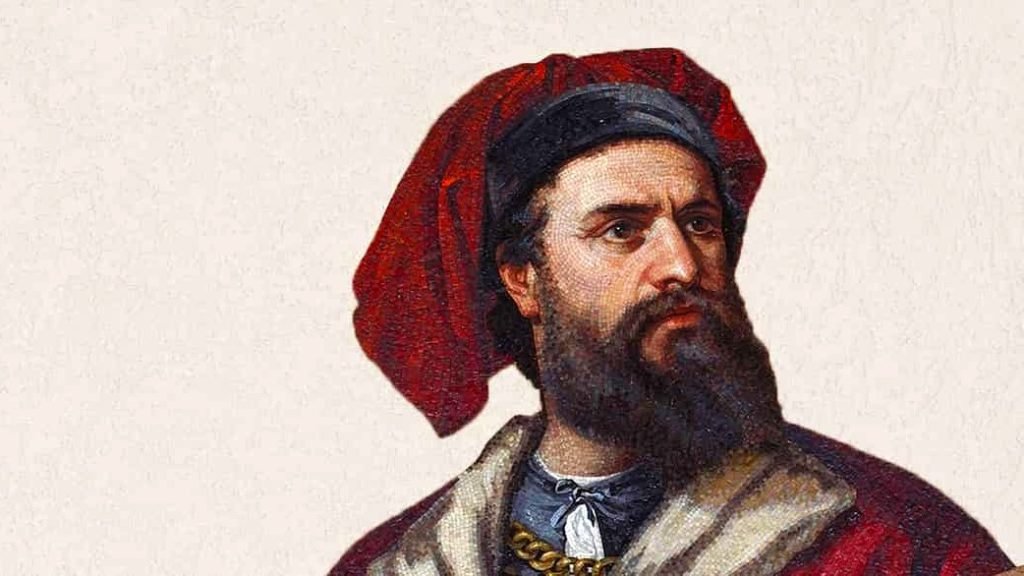
Marco Polo is one of the most recognized names in medieval history. Yet the woman he married is barely known — even to people who are very familiar with his story.
Her name was Donata Badoer. She was a Venetian noblewoman who became Marco Polo’s wife, raised their three daughters, and outlived him by roughly a decade. This article covers what is reliably known about her: her family background, her marriage, her children, and what happened after Marco Polo died.
It also draws a clear line between what history has confirmed and what comes only from genealogy records — because with Donata, that distinction matters.
Who Was Donata Badoer?
Donata Badoer was a Venetian noblewoman, best known as the wife of the merchant and traveler Marco Polo. She is not a modern public figure. Her relevance is historical and genealogical.
Her birth is generally placed around 1280 in Venice. That date comes from genealogy records rather than a confirmed primary source, so it should be understood as an approximation. Her death is estimated to have occurred sometime between 1333 and 1336, though the exact date is uncertain.
This is not unusual for a woman of her era. Medieval documentation about women — even those connected to famous men — is often sparse. Donata is no exception. Most of what survives about her comes through her connection to Marco Polo and through family records compiled long after her lifetime.
Her Family and the Badoer Name
Donata is traditionally identified as the daughter of Vitale Badoer, a Venetian merchant. The Badoer family was an established patrician family within the Republic of Venice.
Patrician families in medieval Venice held real social and legal standing. Being part of that class — or marrying into it — shaped how people lived, did business, and were treated under Venetian law. So Donata’s family background was genuinely significant in a practical sense.
That said, some claims about the Badoer family’s ancient origins are not well supported. Wikipedia’s article on the Badoer family notes that assertions about extremely early ancestry lack factual basis. The family’s prominence is more reliably connected to later periods of Venetian history. It is reasonable to describe the Badoers as an established patrician house without overstating how far back that standing can be traced.
Her Marriage to Marco Polo
Donata and Marco Polo are reported to have married around 1300. By that point, Marco Polo had already completed his famous travels through Asia and returned to Venice. Genealogy sources including FamilySearch and MyHeritage both list 1300 as the marriage date.
The marriage made sense within the merchant-patrician social world of medieval Venice. Marco Polo was a well-traveled merchant with significant experience and reputation. Marrying into a Venetian patrician family like the Badoers would have reinforced his social standing back home.
There is no reliable evidence that Donata traveled with Marco Polo or played any role in his journeys. His travels through Asia, including time at the court of Kublai Khan, all took place before she enters the historical record. She was not a co-author of his famous narrative, commonly known as Il Milione or The Travels of Marco Polo. Her role was that of a Venetian noblewoman — managing household and family life in Venice.
Their Three Daughters
One of the most consistently reported details about Donata’s life is that she and Marco Polo had three daughters. Their names were Fantina, Bellela, and Moreta.
These three names appear across multiple sources — Wikipedia, FamilySearch, and MyHeritage all list them. While those sources are genealogical rather than primary historical documents, the consistency of the daughters’ names across different records makes this detail more reliable than many others in Donata’s biography.
There is no documented record of any sons. The three daughters are also a key reason Donata appears in genealogy databases at all. Without them, the family connection to the Polo name would be harder to trace.
Beyond their names, there is little reliably documented about the daughters’ individual lives, and this article will not speculate about details that are not supported by available sources.
After Marco Polo’s Death in 1324
Marco Polo died in 1324. Donata outlived him by roughly a decade, based on the estimated death range of 1333 to 1336.
Some accounts report that Donata and her daughters were involved in executing Marco Polo’s will after his death. If accurate, this points to her having a recognized legal and family role in Venetian society — not just as a wife, but as someone with real standing in the household’s affairs after her husband was gone.
This detail is reported in secondary historical sources and popular accounts, but it is worth noting that it is not extensively documented through primary sources. It is presented cautiously here as something that has been reported, not as a firmly established legal fact.
Some accounts also mention that Donata was buried near the church of San Lorenzo in Venice, which was reportedly associated with Marco Polo’s own burial. This is treated as a tradition in the available sources rather than something confirmed by strong documentary evidence.
How Reliable Is What We Know About Her?
This is an important question, and it deserves a direct answer.
A lot of what circulates about Donata Badoer online comes from genealogy databases like FamilySearch and MyHeritage. These are useful tools. They can point readers toward names, relationships, and approximate dates. But they often rely on user-submitted family trees, which can contain conflicting or unverified information.
For example, her death date is listed differently across various entries — somewhere in the range of 1333 to 1336, depending on the source. Rather than picking one date and presenting it as settled fact, it is more honest to acknowledge the uncertainty.
The same care applies to her birth date, her father’s identity, and details about her role after Marco Polo’s death. These are all reported details. Some are more consistent across sources than others. The names of her three daughters, for instance, appear in multiple independent references and are among the more dependable facts in her biography.
Think of genealogy entries as signposts. They point toward a connection, but they are not the same as a verified historical record. For a figure like Donata — a medieval woman whose fame rests entirely on her connection to a famous husband — the honest approach is to work with what is reasonably consistent and flag what remains uncertain.
For those interested in researching family history or understanding historical figures in their social and business context, resources like StartBusinessAdvice offer broader perspectives on how family networks and merchant culture shaped lives across different eras.
Why Donata Badoer Still Matters
Donata Badoer is not a famous name. She did not write books, lead expeditions, or hold political office. By the standards of medieval documentation, she left a faint trail.
But she matters for a few reasons.
First, she connects Marco Polo to the social fabric of Venice in a concrete way. His journeys are the part of his story that people remember, but he also came home, married, raised children, and lived as part of a Venetian patrician community. Donata was central to that part of his life.
Second, the existence of three daughters means the Polo family line continued. Those daughters are the reason family trees can be traced at all. Without Donata, the genealogical record of Marco Polo’s family would be far thinner.
Third, she represents something broader: the many medieval women who lived significant lives but left limited records. Her biography is constrained not by her own importance, but by the limits of what was written down about women in her era.
A Brief Timeline
- c. 1280: Donata Badoer is born in Venice, approximately.
- c. 1300: She marries Marco Polo, after his return from Asia.
- c. 1300s: Three daughters — Fantina, Bellela, and Moreta — are born.
- 1324: Marco Polo dies. Donata and her daughters reportedly help execute his will.
- 1333–1336: Donata dies, sometime within this estimated range.
Conclusion
Donata Badoer was a Venetian noblewoman who married one of history’s most famous travelers. She came from an established Venetian patrician family, raised three daughters, and outlived her husband by around a decade.
Her historical record is thin — as it is for most women of her time and class. Much of what is repeated about her comes from genealogy databases rather than detailed primary sources. The responsible approach is to share what is reasonably consistent across sources while being clear about what remains uncertain.
She was not a traveler or a public figure in her own right. But she was a real person, connected to one of the most documented merchants of the medieval world, and her place in history — quiet as it may be — is worth understanding clearly.
Read Also: